Your Back is Stronger Than You Think
A Guide to Managing Acute Lumbar Disc Injuries
If you have ever tweaked your lower back or received a scary MRI report mentioning "herniation" or "bulge," you are likely familiar with the fear that follows. Is my back ruined? Do I need surgery? Will I ever lift weights again? The outlook is much brighter than most people assume. Here is a breakdown of what is actually happening in your spine and the roadmap to recovery.

The Truth About “Disc Injuries”
First, it is vital to normalize the concept of a disc injury. We often view a herniation as a catastrophic event, but clinical evidence suggests it is a normal part of aging.
In fact, more than 50% of asymptomatic people over the age of 30 have evidence of discogenic injury. By age 60, that number jumps to over 80%. This means that just because an MRI shows a bulge, it does not necessarily mean it is the source of your pain. Furthermore, most disc injuries are not even accompanied by leg symptoms.
Why Discs Fail: The Anatomy
To understand why injuries happen, we have to look at load tolerance. Your spinal tissues handle weight very differently:
Bone is incredibly tough, withstanding tensile loads of 2,000–3,500 lbs.
Ligaments can handle 500–1,500 lbs.
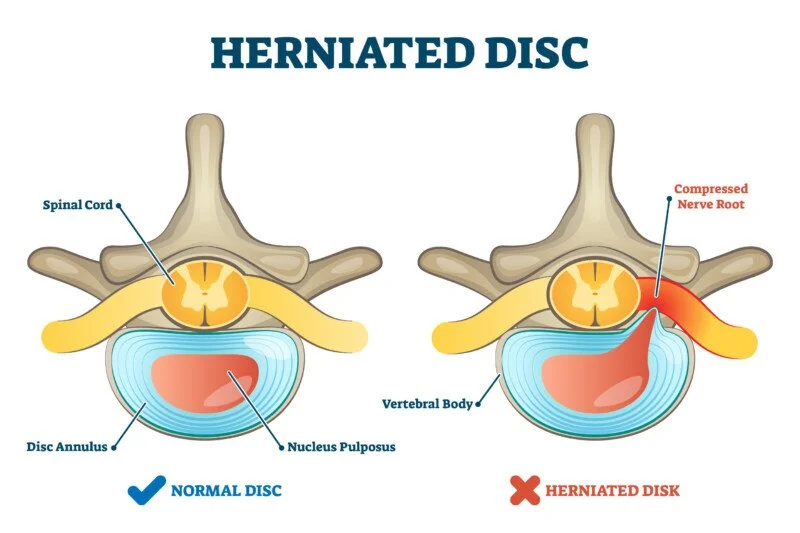
The Intervertebral Disc, however, is the weak link, tolerating only 40–50 lbs.
Because the disc is more fragile, body position matters. Flexion (bending forward) increases the load on the disc, while extension (bending backward) shifts the load to the facet joints. This biomechanical reality is why posture and movement patterns are central to recovery.
The “Wait and See” Strategy Works
One of the most encouraging statistics for patients is the natural rate of healing. The body has a remarkable ability to reabsorb disc material without surgical intervention.
Research shows that within five months:
96% of disc sequestrations (the most severe type) resolve by more than 50%.
70% of disc extrusions resolve.
40% of disc protrusions resolve.
Classifying the Pain
Not all back pain is the same. Clinicians categorize these injuries to treat them effectively:
Discogenic Mechanical LBP: Pain is located in the back due to a tear or bulge, but there is no nerve involvement.
Discogenic Radiculopathy: The disc herniation compresses or irritates a nerve root, causing symptoms (like shooting pain or weakness) in the leg.
Adverse Nerve Tension: A chemical or mild mechanical irritation of the nervous tissue.
Cauda Equina: A rare but serious compression of the nerves centrally in the spinal canal.
The Red Flag: When to Worry
While most injuries heal naturally, there is one major safety warning. Clinicians look for "hard neuro signs"—significant deficits in reflexes, strength (myotomes), or sensation (dermatomes).
If hard neuro signs are present and constant for greater than two weeks, permanent nerve damage can set in. The primary goal during the acute phase is to monitor these signs closely and refer out to a specialist if they do not improve.
Treatment and "The Checklist"
The goal of therapy is Centralization—moving pain from the leg back toward the spine—often utilizing "Directional Preference" (movements in a specific direction, like extension, that relieve symptoms).
But the big question remains: When can I return to heavy lifting or sport?
Here is a "Return to Load" checklist. You should not progress back to heavy loading until you meet these four criteria:
Normalized neurologic deficits (strength and sensation are back).
Minimal neurodynamic deficits (passing tests like the Straight Leg Raise).
80% Range of Motion (ROM).
Minimal to no axial sensitivity (pain in the spine itself).
Once these boxes are checked, patients can begin pre-loading conditioning, utilizing specific protocols like "Abdominals" and the "Back 6-Pack" to prepare the spine for the demands of life and sport.

The Takeaway
Think of a disc injury like a deep bruise on the inside of your spine. Just as a bruise changes colors and fades as the body breaks it down, a disc herniation is often reabsorbed and healed by the body naturally over a few months. The key is respecting the injury's load limits (avoiding flexion if sensitive) and following the checklist before rushing back to the heavy weights. A skilled physical therapist can assist you through this checklist and guide you through the road to recovery.
Let us guide you back to lifting!
Schedule your evaluation with one of our expert Physical Therapists to get started!
ABOUT H.I.R.T.
We are passionate about helping you move and feel your best. Whether you’re just out of surgery or dealing with a nagging injury, our dedicated physical therapists perform detailed evaluations to be identify the exact cause of your pain.
Through personalized programs and care specific to your needs, at H.I.R.T. your recovery is our focus and we’ll do everything to get you back to what you love.