Lifting Heavy with Low Back Pain: What’s Safe, What’s Not, and How to Get Back Under the Bar
You went to the doctor. They told you to stop deadlifting.
If you're a serious lifter, that advice landed somewhere between useless and infuriating. Stopping isn't really an option. Lifting is part of who you are, how you stay sane, and how you stay healthy. And on some level, you already know that taking 6 months off the bar will probably make the next injury worse, not better.
I'm Dr. Sean Harris. I'm a physical therapist with a doctorate in PT and a PhD in rehabilitation science, and I run my practice out of Rise Gym in Houston. I treat a lot of lifters. This is what I tell them when they're trying to figure out what's safe, what isn't, and how to get back under the bar without the back pain coming back every time the weights go up.
The advice you hate hearing is also wrong
The instinct to tell a lifter to "stop lifting" comes from a place that makes sense in a 15-minute appointment with someone who doesn't lift. The provider sees a person in pain, a barbell, and a presumed connection. Eliminate the barbell, eliminate the pain.
The problem is twofold.
First, pain and tissue damage are not the same thing. The science here is overwhelming. People walk around with full-thickness disc herniations and have no pain at all. Other people have completely normal MRIs and severe pain. Your back hurting under load doesn't tell you "the bar is damaging my spine." It tells you "this nervous system is sensitized right now, and the pattern of movement under load is provoking it."
Second, deconditioning makes things worse. The strongest predictor of low back injury in lifters is not how much weight they handle. It's how rapidly they ramp up after time off. If you stop deadlifting for 4 months and then come back to your old numbers, your injury risk goes through the roof. Time off the bar isn't healing — it's just delaying the moment when you find out how detrained you've gotten.
So the question isn't "should I stop lifting?" The right questions are:
What can I keep doing while this calms down?
How do I rebuild back to my old numbers without re-flaring it?
And what's actually causing this in the first place?
What's almost always safe (even with active back pain)
When a lifter walks into my office with low back pain, I almost never tell them to stop everything. Here's what stays in the program, in nearly every case:
Upper body work. Bench, overhead press, rows, pull-ups, accessories — all of it. The brace position required to press isn't loading the spine the way a heavy deadlift does.
Lower body work that doesn't load the spine directly. Leg press, hack squat, leg extensions, leg curls, hip thrusts (often), step-ups, sled work, walking lunges with dumbbells.
Core work that emphasizes anti-extension and anti-rotation. Planks, dead bugs, bird dogs, Pallof presses. These often reduce pain by training the system to brace better.
Cardio. Bike, rower, walking. Cardio is often the most underused tool in a rehab plan for lifters. It reduces nervous system sensitivity and accelerates healing.
The pattern: most things that don't axially load your spine in a way that reproduces your specific pain are safe. The list of what you have to stop is usually much shorter than the list of what you can keep doing.
What's risky during a flare (but not forever)
These are usually the movements to dial back temporarily while pain is active:
Heavy conventional deadlifts — particularly from the floor with significant flexion.
Heavy back squats below parallel if they reproduce your pain.
Stiff-leg or Romanian deadlifts with weight near your maxes.
Good mornings at any meaningful weight.
Any movement that requires deep loaded spinal flexion (sissy squats, certain hyperextension variations).
"Risky" doesn't mean "bad." It means "this is the movement most likely to keep your nervous system stuck in a flare while you're trying to recover." Once the flare has calmed down, these movements come back in a structured way.
The three-phase return to lifting
Most of my lifters follow a version of this:
Phase 1: Calm it down (typically 1-3 weeks)
Symptom-modify. Find the lifts that hurt, swap them for the lifts that don't, and stay active. Add specific exercises that calm the nervous system — usually a mix of repeated motion drills (depending on what direction your back responds to), gentle hip mobility work, and anti-extension core.
The goal here isn't to "rest." It's to keep training while removing the provocations. Detraining starts almost immediately, so we minimize it.
Phase 2: Re-introduce loading (typically 2-6 weeks)
Once the pain is calm and predictable, we start putting the load back on the spine — but at a fraction of your old numbers and with strict form discipline. For deadlifts, this often means starting with elevated pulls (trap bar, blocks, rack pulls from above the knee) at maybe 50-60% of your former working weight, building up over 4-6 weeks.
For squats, often a similar approach: front squats or safety bar before going back to high-bar back squat. Box squats if depth provokes.
You're not detraining your spine here — you're earning back your old loads with progressive loading principles. The body responds to graded exposure. It doesn't respond to either complete avoidance or going back to your maxes immediately.
Phase 3: Rebuild beyond where you were
This is the phase that nobody talks about because most rehab plans end at "pain-free." But "pain-free at light weight" is not the goal. The goal is "stronger and more resilient than before the injury." Otherwise the injury comes back the next time the volume or intensity goes up.
Phase 3 is where we add variation in stance, grip, and tempo; volume bias toward the patterns that were weakest; specific weak-point work (for most lifters, hip extensors and lat/upper back endurance); and a return to your full programming with smarter progression rules.
What's actually causing your back pain (usually)
This is the part most lifters don't hear because most providers don't know the lifter's world. In my practice, the most common root causes I see in lifters with low back pain are:
A rapid spike in volume or intensity — a new program, a new max attempt, a meet prep ramping too fast.
A technique drift under fatigue — your form holds at 70% but breaks at 90%, and you keep hitting 90%+.
Insufficient hip mobility — limited hip flexion forcing the lumbar spine into the position the hips should be handling.
A weak point that's been ignored — usually hip extensors (glutes/hamstrings) or upper back endurance.
Sleep, stress, or recovery debt — the nervous system is more sensitive when you're under-recovered, and the same load that felt fine three months ago now feels threatening to your system.
Notice what's not usually on that list: structural damage from lifting too heavy. The vast majority of lifter back pain isn't from a damaged disc. It's from a temporary perfect storm of the factors above, in a tissue that's actually adapted to handle far more load than it's currently complaining about.
Special cases
Powerlifters — Form analysis and bar speed matter. A flared back during competition prep usually means the technique is drifting under fatigue. Video your sets. Watch your bar speed. Address whichever lift is the provocateur.
CrossFit — Volume management is everything. CrossFit programming doesn't auto-deload, so you have to. If your back is flared, you don't need to stop CrossFit — you need to scale specific movements for 2-3 weeks while the system calms down.
Olympic lifting — Often it's the pulls under fatigue, not the lifts themselves. Look at your pull volume in the week before symptoms started.
Beginner / intermediate lifters — Technique is almost always the issue. Get hands-on coaching. The cheapest investment you can make is a coach who sees your lifts in person.
Get back under the bar
Most of the lifters I work with are back to lifting within 1-2 weeks and back to their old numbers within 8-12 weeks. The ones who try to "just rest it" for months are usually the ones who keep coming back with the same pain a year later, having lost their strength in the meantime.
If you're dealing with back pain that's keeping you from training the way you want to — and you're done with the "just stop deadlifting" advice — we offer a free 15-minute screening call to talk through what's going on. You'll talk to me, not an aide. I'll give you a straight answer on whether PT is the right move, what you can keep doing in the meantime, and what a return-to-lifting timeline actually looks like for your situation.
Schedule a free screening call
You don't have to choose between lifting and a healthy back. You just need a plan that takes both seriously.
Dr. Sean Harris, PT, DPT, PhD, OCS, FAAOMPT, is the founder of Harris Institute for Rehabilitative Therapies in Houston, TX. He treats out of Rise Gym and specializes in spine, sports, and performance-based rehabilitation for strength athletes.
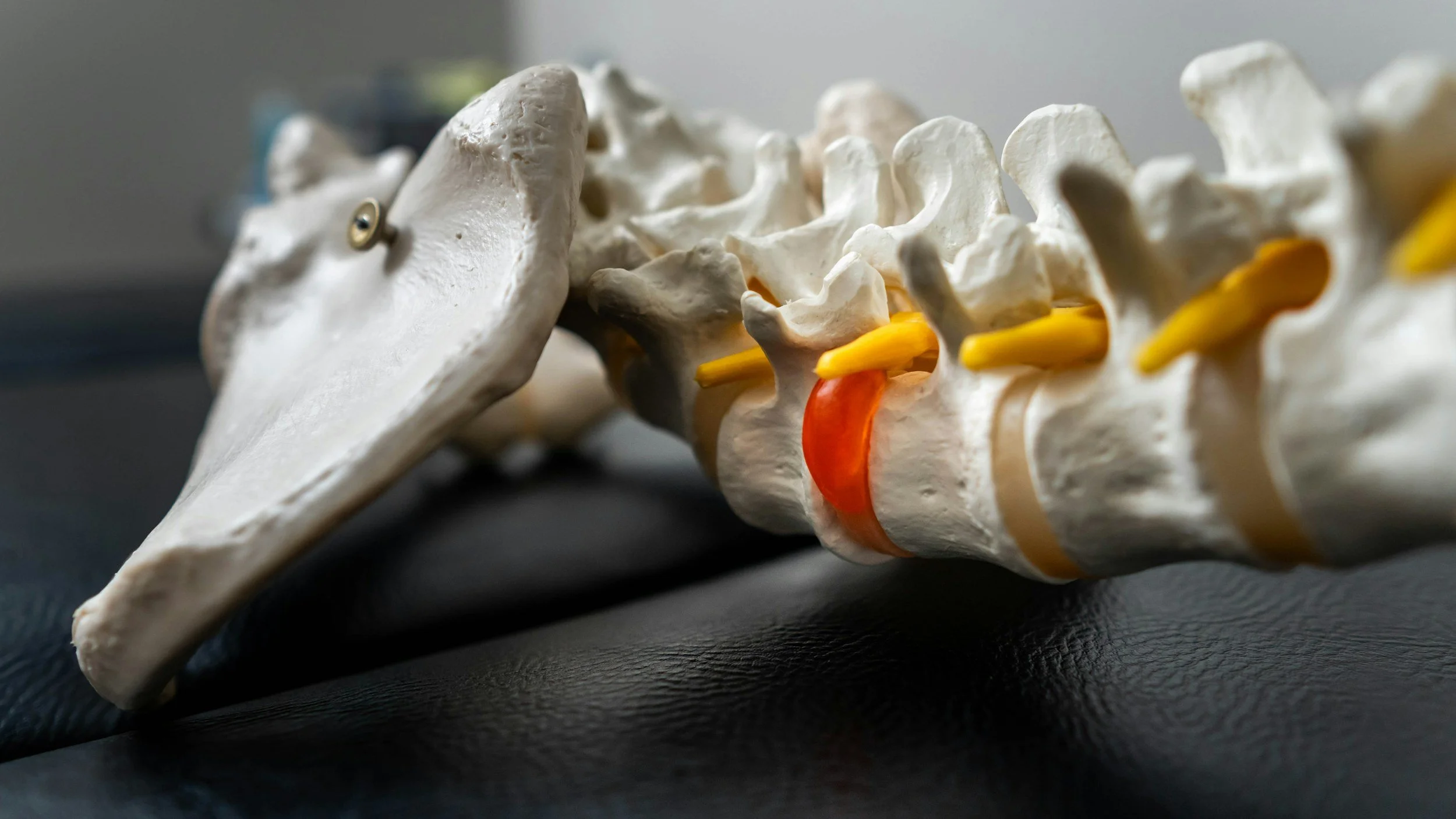
Spinal nerve roots are (shown here) are involved with radiculopathy and radicular pain
At the Harris Institute - we evaluate the differences between these nerve pathologies!